All posts by tedglick

Voting Rights Now!

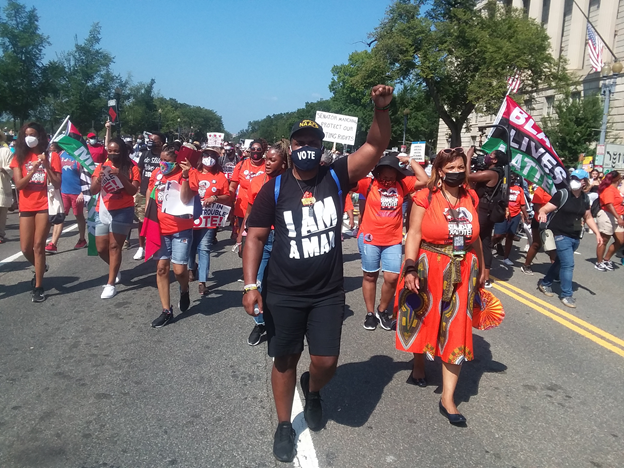
It was hot and humid in DC on Saturday, and I was thoroughly drenched with sweat by the time the March On For Voting Rights arrived in front of the US Capitol. Soon after, the three-hour rally began, with almost all of the thousands there listening from the shelter of the tree shaded grass on either side of the National Mall.

For me, the high point of the program was the consecutive speeches toward the end by 13 year old Yolanda Renee King, Andrea Waters King and Martin Luther King III, respectively a granddaughter, daughter-in-law and son of Martin Luther King, Jr. All were good, substantive, and the fact that they are a family living and working very much in Dr. King’s spirit was personally moving. My life as an activist and organizer literally began on the day he was killed in 1968, so to see and hear his family descendants speaking out so clear and strong was no small thing.

Somewhere in the course of this long, hot day, leaving Newark, NJ on the People’s Organization for Progress (POP) bus at 4 am and getting back about 9 pm, my thinking and feelings about the importance of voting rights shifted. In a way I didn’t before the DC rally, I now feel much more strongly the urgency of the effort to get the US Senate to pass voting rights legislation now.

I’m afraid that too many of us who haven’t directly experienced voter suppression—white people—look upon the right to vote too intellectually, and not from the heart. Of course we support it, we’re democrats. Of course we support it, democracy requires it. If we didn’t support everyone who is eligible to vote being able to do so, it would go against our core beliefs.

Listening to the speakers and feeling the predominantly Black folks around me at the pre-march rally and during the march, it wasn’t the same. For African Americans it is literally a matter of life and death, grounded in centuries of slavery and Jim Crow segregation and institutionalized racism, underlined by today’s out-in-the-open efforts by Republican white supremacists in state legislatures around the country to hijack elections via voter suppression.

Voter suppression has practical results for all people. It could mean the overturning of Roe vs. Wade. It means the entrenchment of the power of the fossil fuel industry at a time when their hold over Washington and other politicians means escalating droughts, fires, major storms, floods and massive human and ecological damage. It means continued and even stepped up mass incarceration of mainly Black and Brown people. It means cutbacks in funds for housing, health care and education. The list is long.

As it turned out, I carried a big POP sign all throughout the march which said, “Stop the Filibuster.” It was a popular sign; lots of people kept coming up to take a picture of it. I was glad to carry it, and as I did so and then heard speakers talking about the need to end the filibuster, at the very least for voting rights related legislation, it became clear how essential this is in 2021. The only way to get something like the John Lewis Voting Rights Act passed is for all 50 Democratic Senators to vote for it and VP Harris to provide the winning vote.

The last speaker at the Capitol Rally, Rev. Al Sharpton, talked about the filibuster. He said we needed a bunch of “filibuster-busters.” He said, “maybe we need to pitch our tents on the Mall.”

Let’s all defend the right to vote this fall, by any and every means necessary!

Ted Glick is a volunteer organizer with Beyond Extreme Energy and author of Burglar for Peace: Lessons Learned in the Catholic Left’s Resistance to the Vietnam War, published last year. Past writings and other information can be found at https://tedglick.com, and he can be followed on Twitter at https://jtglick.com.
Covid Denial on the Left

The Delta variant of Covid-19, combined with regrettable anti-vaccine sentiment, has dramatically escalated the number of covid cases, hospitalizations and deaths in the US and around the world.  The overwhelming majority in the US, over 99% in one scientific study, of those hospitalized and dying are those who have not been vaccinated. And unfortunately, there continue to be progressives who deny the importance of the vaccine to the goal of ultimately suppressing, if not defeating, the virus. They are covid deniers.

It’s difficult to be patient with covid deniers I know who have spent years of their lives advocating and working for a very different world, a much better one, than the corporate-dominated one we are living in today. On this issue, despite the 620,000 deaths in the US and over 4.2 million deaths in the world caused by it so far, with more to come, they act and speak as if those deaths and the massive suffering caused by the virus are essentially the result of a conspiracy.

It is particularly outrageous when people like Gary Null and Robert Kennedy actively encourage people to distrust the vaccine, the vaccine that is THE reason the number of deaths per day in the USA went from over 3,000 in December of 2020 to a few hundred as of this June once the vaccine was widely available and incompetent Trump was replaced by a Biden administration that took this pandemic seriously.

Most of those not getting the vaccine are Trump supporters. A much smaller percentage are people on the Left. From what I’ve read and experienced, some of that second group are people whose general distrust of government and corporations, like Pfizer, Moderna and Johnson & Johnson, underlie their vaccine reluctance.

I agree with those within this group who say that it isn’t enough to wear a mask and social distance and get a vaccine, that it’s also important that people have a healthy diet and exercise, take better care of themselves and their families. I’m critical of Dr. Fauci and Dr. Gupta and other famous medical experts on TV who rarely if ever mention this. Indeed, if they did, this could be a silver lining of covid if many more people made these changes.

And the unwillingness of the pharmaceutical companies to make available the information and the knowledge needed to manufacture the vaccine in other countries is shameful. They should be publicly criticized for their inhuman corporate greed.

But these criticisms can’t be used to discourage vaccination.

I’ve had lots of experience over my years as a progressive activist dealing with people and organizations who put ideology over facts, who refuse to accept the truth, find ways to stick to their opinions even when reality has shown them to be wrong. It’s a very human problem, with deep historical roots. It’s a big problem.

Saying that the vaccine is part of a corporate conspiracy—saying that there’s no need to take the vaccine if you just eat well, take care of yourself and take vitamin supplements—inflating the tiny percentage of cases, much less than 1%, where vaccinated people have been hospitalized or died from the Delta variant—these and other lies and distortions of the truth should not just be dismissed; they should be confronted.

This is not the time for silence. It’s time to stand up against those on the right and those on the left who are sometimes uninformed, sometimes confused, and sometimes—and these are the worst—actively trying to sabotage the efforts to beat the virus through mass vaccination.

Ted Glick is a volunteer organizer with Beyond Extreme Energy and author of Burglar for Peace: Lessons Learned in the Catholic Left’s Resistance to the Vietnam War, published last year. Past writings and other information can be found at https://tedglick.com, and he can be followed on Twitter at https://jtglick.com.

Doom to the MVP Pipeline

Two days ago 100 dedicated climate justice activists, most of them young people, descended upon a site near Roanoke, Va. where the fracked-gas Mountain Valley Pipeline is being built. We arrived there a little before 6:30 am, before the workers had arrived and several hours after we had left our action camp. We had gotten up at 2 am to make this action happen.

The action was a huge success, in many ways. The objective was to shut down the worksite for the day, and that happened! It happened most directly because 10 courageous climate warriors locked themselves both to pipeline construction vehicles and to massive, beautiful, wooden structures created by members of Appalachians Against Pipelines, the organizer of the action. It took until late afternoon for all of the climate warriors to be extracted by the police.

I took a bus from DC organized by Arm in Arm to and from the action camp in West Virginia. On the way back, in the evaluation of the action, someone commented on how near-miraculous the action was, all of the details which had to work together just so for it to be a success: 100-plus people from lots of different places coming together, learning about the plan, fitting in where they wanted to or where it was needed, practicing how we were going to get onto the site, and then in the early morning making it happen.

My thinking as to how this could happen is that one of, if not the, most important reasons was the inclusive and respectful culture which Appalachians Against Pipelines created there on the property where we were getting organized. That respectful culture, combined with our common goal of an effective disruption of pipeline-building business as usual, made for an excellent, powerful action.

In the info packet distributed to participants at the camp, a “Shared Agreements” section succinctly put forward shared values. Here is some of that section:

“How we treat each other:

“We treat each other with respect and compassion.

“We use active listening and ‘I’ statements to the best of our ability when communicating. We strive to be aware of the ways in which we are taking up space, and try to ensure we make enough spaces for voices that aren’t being heard in our environment.

“We respect a diversity of experience. We explicitly and enthusiastically welcome people new to the movement.

“We ask people to commit to questioning their privilege and to be open to being challenged. When someone challenges us to expand our understanding or shares that we have hurt them, we recognize this as an act of love, appreciate their vulnerability, and immediately make listening our top priority.

“We recognize that we are human, we make mistakes, misjudgments and missteps, therefore we seek to avoid humiliating exposure when issues arise. We try not to ‘call out’ with blaming or shaming but instead ‘call in’ with compassion, prioritizing our collective growth and understanding.

“We will not perpetrate violence against each other. This includes emotional, psychological and spiritual violence as well as physical violence.

“We will refrain from engaging in culturally appropriative practices. Do not bring objects or symbols, engage in acts, or wear clothing or hairstyles that are sacred or significant to a culture other than your own.”

The importance of these kind of values, this kind of movement culture, in all of our work of world-changing cannot be overstated. There is a very, very long history among people on the Left of disagreements and differences leading to intense divisions leading to the downfall, downsizing or dismantling of movements and organizations, as people who joined full of hope and energy get demoralized and leave.

This cannot happen to any significant degree with today’s people’s movement! We must change the world because the alternative is a world whose ecological, social and economic systems will be severely disrupted for a very long time, with great human misery, especially for people of color and low-wealth people.

History has shown us that we will not change the world if we, the change agents, do not change ourselves and others. As the late Fr. Paul Mayer has written, “What history is calling for is nothing less than the creation of a new human being. We must literally reinvent ourselves through the alchemy of the Spirit or perish. We are being divinely summoned to climb another rung on the evolutionary ladder, to another level of human consciousness.”


Ted Glick is a volunteer organizer with Beyond Extreme Energy and author of Burglar for Peace: Lessons Learned in the Catholic Left’s Resistance to the Vietnam War, published last year. Past writings and other information can be found at https://tedglick.com, and he can be followed on Twitter at https://jtglick.com.

Keeping the Faith

July 21st was the 42nd anniversary of my and my wife Jane Califf’s 1979 wedding. 20 years later, in 1999, we had a 20th anniversary gathering in our backyard in northern New Jersey with about 50 of our closest friends and relations. We filmed that event, and last evening, for the first time in 22 years, we watched it.

We were all eyes and ears as the video showed the circle of participants. About a quarter of those present then are no longer alive. Everyone else, of course, was 22 years younger, some of whom, today, are having their significant life and medical issues. It was a startling reminder of the reality of mortality all of us must deal with.

In the video Jane and I re-read the vows we had taken 20 years before, and last evening we felt like we had done a pretty good job sticking to them. In the video we also each reflected out loud with our 20th anniversary thoughts and feelings, there together with those we considered part of our extended family, whether by blood or otherwise.

One of the things I spoke about was the importance of connections—connections to family and friends, connections to the natural world, connections to those who have come before us, and connections to those coming after us. I said that our marriage was able to survive and deepen in large part because Jane and I consciously worked at maintaining all of those connections over the years.

In 1997, a couple years before this 20th wedding anniversary event, I wrote a poem about connections, Our Awesome Task. These were the concluding verses:

“Where do we look for strength in times like these–hard times, struggling times, fighting-seemingly-insurmountable-odds times?

“To one another, as we learn the “to” (one another) and not the “on” that has been
our history on the Left, within the union structures, in our other organized efforts–the competition, the pettiness, the backstabbing, the dishonesty–a history that must be, and fortunately is, being transcended.

“Some find strength in spiritual traditions, even rituals, connecting us to one another, to those before, to the natural world.

“Some love and meditate on “God”–Truth, Justice, Compassion–(“And what does God require of you but to do justice, and to love kindness, and to walk humbly with your God?”) —with all their heart and soul, and their neighbors as themselves, fulfilling Humankind’s Greatest Commandment.

“Some gather children, grandchildren, neighbor children, friends’ children, students
around them–‘and the little children shall lead them.’

“And some of us just muddle along, doing the best we can, learning from history,
understanding the historical truth, the law of physics, that for every action there is a reaction–that oppression breeds resistance–that, as Dr. King said, “The arc of the universe is long, but it bends toward justice.”

“Accepting–we have no choice!–our limitations, our limited power right now, while never accepting injustice and evil, the evil system we must transform;

“Using our anger, our outrage, our humanity, our love, burning like a low flame, a pilot light, flaring up as necessary into a burning torch to lead others into a future, a future world, we must, we have to, claim and win.”

The poem articulates a macro overview of ways that we can keep the faith and keep going despite all the many obstacles we encounter. But, ultimately, keeping the faith requires each of us to develop specific daily or weekly ways to keep the higher purposes, Higher Love, foremost in our consciousness.

Howard Thurman, an African American minister who was active in the 60s Black Freedom Movement and a close friend of Martin Luther King, Jr., has written very perceptively and non-religiously about this way to “regain perspective:”

“The restlessness of our age, the churning tumult of our times, the quiet frustrations and the riotous frustrations in the midst of which we live, all these surround us in the quietness, and yet we recognize the privilege of unhurried contemplation, of laying ourselves bare to the searching processes of singleness of mind, the privilege of becoming aware of needs of which we are scarcely conscious in our fevered rush, the privilege of hearing voices that need not speak above a whisper in our hearts, pointing us to the way that we should take in the midst of our own problems and responsibilities, our own hopes, and our own fears. The time of regaining of quiet. The time of searching of heart. The time of regaining of perspective. The time of lifting of hopes about ourselves and the world. The time of insight. The time of the renewal of courage.” 
            -Howard Thurman, Sermons on the Parables **

In this “churning tumult of our times,” we must daily strive to let our inner light shine, an inner light kept alive not by accident but by conscious intention, in whatever ways we each determine to do so.

**Sermons on the Parables, edited by David B Gowler and Kipton E. Jensen, Maryknoll, NY: Orbis Books, p. 5


Ted Glick is a volunteer organizer with Beyond Extreme Energy and author of Burglar for Peace: Lessons Learned in the Catholic Left’s Resistance to the Vietnam War, published last year. Past writings and other information can be found at https://tedglick.com, and he can be followed on Twitter at https://jtglick.com.

Sabotage?

“How to Blow Up a Pipeline” is a book written by a Swedish climate activist and writer, Andres Malm. It was published earlier this year by Verso. A friend who read my Burglar for Peace book and knew about my belief in strategic nonviolent direct action recommended it to me.

The book is a call for greater seriousness in action by those of us who get it on how urgent the climate emergency is. By greater seriousness, Malm means one thing: sabotage.

I have some experience with what could be called “sabotage.” In the winter of 1972 I spent weeks working with a team casing an AMF factory in York, Pa. that made bomb casings for seeing-eye bombs to be dropped in Indochina. In late March several of us entered a railroad box car loaded with hundreds of these casings and proceeded to use a powerful bolt cutter to make a gash in the threads at the top, permanently putting these planned bombs out of commission.

The action happened right at the beginning of the trial of the Harrisburg 7, indicted for a supposed conspiracy to kidnap Henry Kissinger and blow up heating tunnels under Washington, D.C. I was the eighth defendant indicted but I was severed from the trial of the other seven right before trial because I insisted on my right to defend myself.

There was no plan to kidnap anyone or blow up anything, though Phil Berrigan, Catholic priest and founder and leader of this ultra-resistance network, had given serious thought to the idea of shutting down government buildings on a winter day by puncturing steam pipes providing heat to government buildings. After consideration and some exploration, the idea was dropped in part because of concern that if the action was successful and steam was released, it could burn or kill homeless people who slept on the warm grates.

This sabotage idea, and the actual sabotage action in York, were undertaken by activists in the Catholic Left. For years a series of raids on draft boards, war corporation offices and FBI offices did both political damage and, in the case of the hundreds of thousands of draft files destroyed, practical damage to the government’s war machine. I was part of all of this for about three years, including 11 months in prison.

Malm’s book brought back these memories. I thoroughly identify with his feeling that the climate emergency is so serious and the response of the world’s governments so weak, given the continued growth in greenhouse gas emissions and the very serious threat it poses to human society, that some of us need to consider much stronger action. Like what? Here’s what Malm writes at one point:

“So here is what this movement of millions should do, for a start. . . Damage and destroy new CO2-emitting devices. Put them out of commission, pick them apart, demolish them, burn them, blow them up. Let the capitalists who keep investing in the fire know that their properties will be trashed. If we can’t get a prohibition [of all new CO2-emitting devices], we can impose a de facto one with our bodies and any other means necessary.” (p. 67)

Elsewhere Malm writes approvingly of stone throwing and “revolutionary violence as an integral component.” He reviews the history of pipeline sabotage in various popular struggles against repressive governments. He attacks pacifism on strategic grounds and writes of the fact that mass struggles for major change often involve use of both nonviolence and people who are armed or who take violent action. He writes of focusing property destruction on the property of the rich, on “luxury emissions.” He tells about being involved years ago in organized vandalizing of SUV cars in rich neighborhoods.

And yet, he then seems to have second thoughts.

He writes that “strict selectivity would need to be observed. There was a randomness to the property destruction undertaken by the suffragettes [in England in the 1910’s], which wouldn’t do now.” (p. 69) We need to recognize, he says, that “it will be states that ram through the transition or no one will. . . [With] “a Green New Deal or some similar policy package, property destruction would appear superfluous to many.” (p. 118)

And violence carries political risks: “In the eyes of the public, in the early twentieth-first century and particularly in the global North, property destruction does tend to come off as violent.” (p. 101) “Because of the magnitude of the stakes in the climate crisis, negative effects could be unusually ruinous here.” (p. 121)

He spends a number of pages addressing the issue of property destruction as it compares to tactics which can hurt or kill people. He gets it that there is a difference.

Back during the Vietnam War, those who initiated the Catholic Left actions to destroy draft files—doing so in ways that insured the only people who might get hurt would be those doing the actions, no one else—experienced criticism from more than a few people in the peace movement. There was concern that such actions would help the government paint the movement as violent.

Over time, however, as participants in the first actions openly revealed their identity, explained why they were moved to risk years in prison, and argued that destroying pieces of paper sending young men to Vietnam to kill and die was in no way violence, the political dynamics in the country changed. By 1972, people arrested inside the Camden, NJ federal building about to break into draft boards were acquitted of all felony charges by a jury.

As far as I know, there has been one major act of property destruction related to climate in the US. In 2016 and 2017 two young women, Jessica Reznicek and Ruby Montoya, members of the Des Moines, Ia. Catholic Worker movement, burned pieces of heavy equipment at construction sites of the Dakota Access Pipeline. They eventually decided to make themselves known so that they could explain why they did what they did. Malm quotes them saying, “We are speaking publicly to empower others to act boldly, with purity of heart, to dismantle the infrastructure which deny us our rights to water, land and liberty. We never at all threatened human life. Nothing was ever done by Ruby or me outside of peaceful, deliberate and steady loving hands.” (p. 98)

Three weeks ago Reznicek was sentenced to eight years in prison, and Montoya will be sentenced at the end of this month.

50+ years ago I don’t remember once talking with others in the Catholic Left about “sabotage.” I think I know why. Those older and wiser leaders of this wing of the peace movement, like Phil and Dan Berrigan, wanted to keep the focus of what we were doing on the WHY, on the war victims, the draft-age young men, the threat of wider and wider war. I am sure that they felt that to talk or write about what we were doing as “sabotage” was, in essence, playing into the hands of our militaristic and imperialist enemies.

Ultimately, it is not the words we use but the actions we take which are important: actions appropriate to the urgency of our situation—actions which do not lead to serious injury or death of others—actions which cannot be painted as mindless, reckless violence—actions which educate and motivate others, build the movement—and ultimately, actions which help to build so much political pressure on government leaders that they finally must do the right thing.

As Albert Camus said, “Real generosity toward the future lies in giving all to the present.”


Ted Glick is a volunteer organizer with Beyond Extreme Energy and author of Burglar for Peace: Lessons Learned in the Catholic Left’s Resistance to the Vietnam War, published last year. Past writings and other information can be found at https://tedglick.com, and he can be followed on Twitter at https://jtglick.com.

Walking and rocking for a fossil fuel free world

When the planning began, four or so months ago, for what became a nine-day, 175 mile, 2021 Walk For Our Grandchildren that ended two days ago, the pandemic was still strong. It was weakening, as the Biden Administration from day one made its defeat its top priority, but up until a month or so ago the first thing we talked about on our weekly Walk planning calls was the pandemic and if we should keep moving forward, or adjusting, our planning.

Biden and his administration deserve credit for their leadership on this huge issue. But when it comes to the existential issue of the deepening climate emergency, it’s a different story. And that is why from June 20 to June 28, from Scranton, Pa. to Wilmington, De., from Biden’s birthplace to his current home, a core group of about 20 people, most but not all grandparents, walked, rode, met with local activists, rallied, picketed, demonstrated and, on the last day in downtown Wilmington, in front of a major Chase Bank corporate headquarters, blocked a major intersection by sitting in 10 rocking chairs, leading to 15 arrests.

200 or more people took part in one or more of the 18 different events over these nine days. 70 organizations supported it, many of them frontline groups fighting fracking and proposed new fossil fuel infrastructure. A highlight of the press coverage we received was in Scranton, where good stories were aired by three local TV stations, and two consecutive days of coverage was given to us by the major local daily newspaper. Two TV networks came to our Independence Hall rally in Philadelphia. A daily Wilmington area paper carried a good story on the civil disobedience action in front of Chase.

All along the way we passed out half-page leaflets which explained why we were walking: “We stand with local people whose air, water and land are being poisoned by oil and gas pollution and whose health is suffering. We demand that Chase Bank stop its massive funding of fossil fuel companies. We call for keeping fossil fuels in the ground to prevent the escalation of destructive weather events for the sake of future generations and all life on earth. The current proposals by the Biden administration to address the climate emergency and many environmental injustices are inadequate. We need a rapid, uncompromising transition away from the extraction and burning of toxic fossil fuels while embracing renewable energy, especially solar and wind power.”

On a daily basis, we were gratified by the support given to us and expressed by people we encountered as we were walking, or who had stepped forward to give us floor space to sleep in their church or temple or lawn space on their property to camp. Local organizers all along the route responded to our plan to undertake this walk and worked with us to organize successful local actions and gatherings. The wonderful people from Seeds of Peace kept us well-fed with their traveling food-service operation.

There were challenges all throughout these nine days: high heat and humidity for about half of them; a strong wind and rain storm that came through Scranton on the second night and forced us to alter our plans for the next day as we dealt with lots of wet tents, clothes and continuing rain for most of the third day; rain on day seven as we walked along the 291 Industrial Highway to Chester and Marcus Hook, Pa.; and just staying on a very packed schedule of walking, actions, public gatherings, walker gatherings and dealing with the logistics of the trip.

We got through all of this because we had to, because there was a shared and openly expressed feeling about how urgent the issues are that we were addressing. That feeling built as we met and talked with local people along the way dealing with the negative impacts of a toxic, extractive, fossil fuel economy, a corporate-dominated economy, which puts profits for a tiny few above the health and wellness of the many. On this walk, we saw, smelled, learned about and were moved, over and over again, by those realities.

Without a doubt, the walk deepened our personal commitments to do all that we can both right now, when Biden and Congress need strong pressure to do the right thing legislatively, and for years to come to change this unjust, unequal, corrupt and polluting system.

 
Ted Glick is a volunteer organizer with Beyond Extreme Energy and author of Burglar for Peace: Lessons Learned in the Catholic Left’s Resistance to the Vietnam War, published last year. Past writings and other information can be found at https://tedglick.com, and he can be followed on Twitter at https://jtglick.com.

It’s Time to Hit the Streets

For the last 15 months, since the first economy-wide shutdowns because of the pandemic, in-the-streets activism on the political Left has been rare. The huge exception was the massive, Black-led, multi-racial response of many millions of people all around the country last summer after George Floyd was murdered. Another exception is the heroic fight led by Indigenous women in Minnesota against the building of another tar sands pipeline, Line 3, across Anishinaabe and other land. Tomorrow, June 7, could see a thousand or more people risking arrest as part of that months-long direct action campaign.

The Sunrise Movement is also shifting gears, away from the zoom-call-only mode into something much more visible. Several days ago they sat in at the White House and on June 28 they are planning a major DC action—Biden Be Brave, No Compromise, No Excuses–demanding that “Democrats must take their power seriously and stop negotiating with a GOP which is not serious about climate action or delivering jobs for the American people.”

Also in late June, from the 20th to the 28th, there will be a 2021 Walk For Our Grandchildren from Scranton, Pa. to Wilmington, De. “to remind the Biden Administration and others that our love for our families and their futures requires a rapid, uncompromising transition away from the unhealthy, unsafe extraction and burning of fossil fuels while embracing renewable energy, especially solar and wind power.”

This upsurge of in the streets activism is happening, not coincidentally, at the same time that COVID 19 is being defeated, at least in the US and at least for now. This is the case primarily because of the effectiveness of the vaccines and the effectiveness of the vaccination campaign begun on January 20th when Biden/Harris took office. The science is telling us that, at least for this summer, many things that couldn’t happen over the last 15 months now can.

It is essential that our movement of movements on a wide range of issues recognize and act upon this new reality. From a strategic perspective, as far as how fundamental social, economic, political and cultural change happens, actions in the streets are essential. We must intelligently organize public marches, demonstrations, work and hunger strikes and nonviolent direct actions that underline the seriousness of our issue campaigns, inspire millions of people who hear about them, and bring pressure to bear on decision-makers to do the right and needed things.

This is not the only thing we need to be doing. It is also essential that our movement be grounded in day-to-day, community-, workplace-, and issue-based organizing by millions of volunteer and paid activists and organizers, utilizing popular education, dialogical approaches and techniques as much as possible. And we need to engage in the electoral arena, supporting independent and progressive candidates, and sometimes, for tactical reasons, people like Biden because of the threat from the Trumpists, racists and neo-fascists. We need do this from the most local to the highest national level, doing so in a tactically flexible way as far as whether to run on a Democrat, independent, Working Families, Green, or other line.

At any one time, one of these three legs of our movement-building stool—street action, electoral action and day-to-day dialogical organizing—will take precedence. In 2020 electoral action was the priority. Right now street action, holding those elected accountable, bringing political pressure to bear, has to be the priority, and not just via zoom calls. It’s time to hit the streets!


Ted Glick is a volunteer organizer with Beyond Extreme Energy and author of Burglar for Peace: Lessons Learned in the Catholic Left’s Resistance to the Vietnam War, published last year. Past writings and other information can be found at https://tedglick.com, and he can be followed on Twitter at https://jtglick.com.

Walking For Our Grandchild

A little more than three weeks from now, my wife Jane Califf and I will head west to Scranton, Pa. to join with others in the eight-day, 2021 Walk For Our Grandchildren and Mother Earth: Elders and Youth on the Road to Climate Justice. The Walk begins in Scranton on June 20, Father’s Day, and will end in Wilmington, De. on June 28. On that day we will take nonviolent direct action at a major corporate headquarters of Chase Bank, the world’s leading financial supporter of the fossil fuel industry.

Eight years ago I helped to organize the 2013 Walk For Our Grandchildren, from Camp David in Maryland to the White House via Harpers Ferry. That one ended with about 60 people being arrested at the offices of Environmental Resources Management, the greenwashing company that did the KXL oil pipeline’s official environmental impact statement.

Many of the people who I met and walked with in 2013 ended up joining together the next year to take nonviolent direct action at the headquarters of FERC, the Federal Energy Regulatory Commission, out of which emerged the organization Beyond Extreme Energy. BXE is still going strong, supporting frontline groups fighting new fracked gas infrastructure and advocating with increasing effectiveness for FERC to be replaced by FREC, a Federal Renewable Energy Commission.

For Jane and me this year’s Walk will have one very big difference: as distinct from back then, today we are actual grandparents. Earlier this month, with the pandemic thankfully receding, we spent time in Montana with four month old grandson Rio and our son and daughter-in-law, and unsurprisingly, we fell deeply in love with him.

It helps to personalize why we are working and struggling and fighting, day after day, for a very different future than the one we are facing absent very big societal changes.

Many years ago, in 2006, I did this personalization as I climbed up a ladder onto a ledge about 25 feet above the DC area entrance to NOAA, the National Oceanic and Atmospheric Administration. I did so as part of a campaign being conducted by the Chesapeake Climate Action Network the year after Hurricane Katrina, calling upon NOAA to release a study they had done of the connections between global heating and stronger and more destructive hurricanes.

In preparation for this action I practiced climbing up a 32 foot ladder behind the CCAN office. Doing so wasn’t easy because I have a fear of heights. I had to figure out a way of keeping down my fear as I climbed those rungs, and what I did was to think about my two great nieces, 1 and 4 years old at the time, and how I needed to overcome my fear so that, hopefully, their world would be a much better one than today’s. I ended up writing a poem about this experience, “The Ladders, Then and Now, and Abby and Ellie.”

I am sure that as we move from Joe Biden’s birthplace to his Wilmington home town on this year’s Walk, Jane and I will be thinking often about Rio, gaining energy to keep walking in the expected summer heat. But if we weren’t actual grandparents, we would still be taking part.

Right now is a critical time for visible action to demand that President Biden and Democrats in Congress take seriously their responsibility to act now, this summer, as part of the American Jobs Plan, to accelerate the urgently needed shift off of fossil fuels to renewables—solar, wind, moving water and geothermal. It’s time to put a stop to the construction of Line 3 and the building of any new fossil fuel infrastructure, which even the International Energy Agency just last week said must be done if we are to reach the world’s Paris Climate Agreement goals and prevent worldwide climate catastrophe. It’s time to step it up!

(For information on the Walk For Our Grandchildren and to sign up, go to About | 4ourgrandchildren (wixsite.com)


Ted Glick is a volunteer organizer with Beyond Extreme Energy and author of Burglar for Peace: Lessons Learned in the Catholic Left’s Resistance to the Vietnam War, published last year. Past writings and other information can be found at https://tedglick.com, and he can be followed on Twitter at https://jtglick.com.

Israel/Palestine!

Indian independence leader Mohandus Gandhi was a believer in nonviolence as the most effective way to bring about social change, but he also believed that violent resistance is better than surrender to oppressive conditions.

Clearly, Israel’s open-air imprisonment of the people of Gaza and the continuing, expanding, illegal, Israeli occupation of major portions of the West Bank are conditions that people will resist, in small ways daily and in bigger ways when conditions ripen for mass resistance, whether nonviolent or violent. That, above all else, is the underlying reason for the war now raging.

It is a good thing that political pressure from most of the world’s nations, the grassroots in the US and from progressive Democrats and independents in Congress is having an impact on Biden, given the historic role of the US as a deep-pockets enabler of Israel’s repressive policies. As this is being written, he is toughening his stance toward Israel’s once-again, death-from-the-skies, disproportionate response to Hamas’ barrage of missiles.

I wonder what a Trump administration would be doing if they were in power now. It’s hard to see them doing anything other than cheering on their fellow right-winger Netanyahu, with potentially huge implications for the entire West Asia region.

It has been a positive thing to see the progressive wing within the Democratic Party stepping forward only a few days into this latest violent war to demand that the Biden Administration support a cease fire, halt the shipment of weapons to the Netanyahu government and act as if it is genuinely concerned about not just Israelis but Palestinians also. From what I’ve seen in the liberal mass media, this position has been presented there as a legitimate one.

In today’s New York Times, for example, in a front page article with a headline, “Gaza Reels From Strikes That Underscore Scope of Deep-Rooted Misery,” they report in the second paragraph that, “Sewage systems inside Gaza have been destroyed. A desalination plant that helped provide fresh water to 250,000 people in the territory is offline. Dozens of schools have been damaged or closed, forcing some 600,000 students to miss classes. Some 72,000 Gazans have been forced to flee their homes. And at least 213 Palestinians have been killed, including dozens of children.”

“Genocidal” is the word that comes to mind for what Israel is now doing.

It is also positive to read in another article in the Times that “hundreds of thousands of Palestinian citizens of Israel stopped work for the day on Tuesday, as did other Palestinians across the occupied West Bank and in Gaza, protesting violence against Arab Israelis, the unfolding Israeli military campaign targeting Hamas militants in Gaza and the looming eviction of several families from their homes in East Jerusalem.”

I hope this successful day of mass nonviolent action is the beginning of a Palestinian mass movement that will continue and grow in its impact, and I hope that growing numbers of non-Palestinian Israelis join with them.

And for those of us in the USA, we need to keep coming out for demonstrations being organized around the country in support of a cease fire and, ultimately, genuine justice, equality and peace in Israel/Palestine for all of its peoples.

Ted Glick is a volunteer organizer with Beyond Extreme Energy and author of Burglar for Peace: Lessons Learned in the Catholic Left’s Resistance to the Vietnam War, published last year. Past writings and other information can be found at https://tedglick.com, and he can be followed on Twitter at https://jtglick.com.

FERC: From Rubber Stamp to Climate Action Leader?

(This is testimony that I presented publicly to the Federal Energy Regulatory Commission (FERC) commissioners last Friday at an all-day FERC workshop to move toward setting up an Office of Public Participation, 43 years after it was authorized by Congress. I testified on behalf of Beyond Extreme Energy, which has been taking nonviolent direct action at their headquarters in DC and putting as much pressure as possible on them since 2014.)

I have been interacting with and experiencing FERC for the last decade. As the gas industry has expanded nationally I have been involved with numerous efforts to prevent the imposition of pipelines, compressor stations and export terminals. I’ve done so in the county, Essex County, NJ, where I live, in other parts of NJ, in the Md/DC/Va. area when I was the National Campaign Coordinator of the Chesapeake Climate Action Network, and nationally through CCAN and the organization Beyond Extreme Energy.

A constant among all of these experiences is that FERC has operated as a willing partner with the gas and pipeline industries, making sure that in virtually every single case they get their permits to expand their operations. It doesn’t matter if the number of comments opposing a project is 99-1 opposed; they’ll get their permit, their Certificate of Public Convenience and Necessity. That’s why FERC is widely seen by those who experience it as a rubber stamp agency. According to the House Committee on Oversight and Reform, in a release put out in April of last year, “FERC has a pattern of rubber-stamping these certificates.  According to data submitted to the Subcommittee, in the past 20 years, FERC has granted 1,021 certificates, while rejecting only 6, a greater than 99% approval rate.”

The main responsibility of a new Office of Public Participation must be to end this rubber-stamping process, create a level playing field in which the opinions of local landowners, communities and towns on proposed projects are taken seriously. For this to happen, several things are necessary.

First, an OPP must be adequately staffed, both numerically and with people who have expertise and experience in democratic community organizing and governance. With all due respect to those who must work within a necessarily bureaucratic structure, there is a difference between democratic and participatory ways of work and bureaucratic ways.

Second, environmental justice concerns must be central to the functioning of an OPP. This means there must be people of color and people from low-income backgrounds part of the staff, and these issues must be prioritized. Indeed, for FERC as a whole, we would urge that an Environmental Justice Impact Statement for proposed new energy infrastructure, as well as an Office of Indigenous Relations, become part of the functioning of a new and reformed FERC. We need a 21st century federal energy regulatory agency, not one mired in 20th century thinking and practices.

The Office of Public Participation cannot be an operation separated out from the rest of the way FERC operates. The concept of “public participation,” of genuine community involvement, of taking seriously the concerns of local people affected by proposed projects and policies, must permeate all of FERC. This means that current FERC leadership must take on the issue of fossil fuel industry influence over and corruption of the way FERC operates. All of the many ways that this happens, from the revolving door between FERC employment and industry employment, to the hiring of contractors with deep industry ties, to hiring industry-connected individuals to lead FERC departments, and more, all of these must be identified and changed. FERC’s culture must change from one of industry participation and influence to one of genuine popular participation and influence.

And if that can’t happen, if it is just too deeply rooted, FERC needs to be replaced with a new federal energy regulatory agency that can do so.

Ted Glick is a volunteer organizer with Beyond Extreme Energy and author of Burglar for Peace: Lessons Learned in the Catholic Left’s Resistance to the Vietnam War, published last year. Past writings and other information can be found at https://tedglick.com, and he can be followed on Twitter at https://jtglick.com.