All posts by tedglick

Jesus the Carpenter

“Jesus Christ was a man that traveled through the land,
A Carpenter true and brave;
He said to the rich, ‘Give your goods to the poor,’
So they laid Jesus Christ in his grave.

“Yes, Jesus was a man, a carpenter by hand,
A carpenter true and brave,
And a dirty little coward called Judas Iscariot
He laid Jesus Christ in His grave.

“He went to the sick and He went to the poor,
He went to the hungry and the lame;
He said that the poor would win this world,
So they laid Jesus Christ in His grave.”

     -Woody Guthrie, “Jesus Christ Was a Man,” 1940

As someone raised in a Protestant church, and who goes to one now, I’ve been getting progressively into the Christmas season, in a good way. I haven’t been running around getting presents; without kids or grandkids nearby, that’s not a priority. But I have been thinking more than usual about Jesus of Nazareth, who Jackson Browne called “the rebel Jesus.”

Several days ago I heard for the first time a song which got me thinking I should write one of these columns. The name of it is, “A Strange Way to Save the World,” by David Allen Clark, Donald A. Koch and Mark R. Harris. Here’s the words which got me thinking:

I’m sure he must have been surprised
At where this road had taken him
Cause never in a million lives
Would he have dreamed of Bethlehem

And standing at the manger
He saw with his own eyes
The message from the angel come to life
And Joseph said

Why me, I’m just a simple man of trade
Why Him with all the rulers in the world
Why here inside this stable filled with hay
Why her, she’s just an ordinary girl
Now I’m not one to second guess
What angels have to say
But this is such a strange way to save the world.

These words made me remember one of the first times I heard this kind of analysis of the specialness of the birth and life of Jesus of Nazareth, born to a prematurely pregnant mother, in the eyes of society, born in a barn, born with a carpenter father, living with his people under Roman occupation. I heard it about 40 years ago in the House of the Lord Church in Brooklyn, NY from the church minister, Rev. Herbert Daughtry. Rev. Daughtry was a leader of the National Black United Front and a dedicated social justice activist.

Daughtry eloquently and passionately roused the congregation, me included, as he pointed out in different ways the significance of who this person was, this man who became a “son of God” and birthed a religion which, for 200 or so years after his death, was all about world-changing and person-changing, both together, through acts of charity and acts of resistance to evil.

As I think about Jesus in this Jesus birthday season, this is who I will remember. In that way, if not in other ways, he, and so many others like him down through history who acted and suffered for the common good, will continue to live on in my and others’ hearts and minds.

Ted Glick works with Beyond Extreme Energy and is president of 350NJ-Rockland. Past writings and other information, including about Burglar for Peace and 21st Century Revolution, two books published by him in 2020 and 2021, can be found at https://tedglick.com. He can be followed on Twitter at https://twitter.com/jtglick
It’s Time to Occupy Biden

A tough year is ending on a bad note. Not only are Covid cases rising fast but, because of Manchin and Sinema, the Build Back Better act is in serious trouble. On top of that, Joe Biden hasn’t exactly been the leader on the climate emergency, and on numerous other issues, that is needed. Joe is not Bernie. But, sigh, at least he’s not Trump.

Politics ain’t beanbag, I’ve heard it said. In the game of beanbag you either throw it in the hole or you don’t. In politics, the way it’s played in Washington, DC, big money, fossil fuel money, billionaire money corrupts and makes clear-cut victories for the people and Mother Earth rare. What victories are won are almost always partial or limited.

This reality makes it essential, absolutely essential, that we keep up the street heat, the mass demonstrations, the nonviolent direct action, the grassroots organizing. It is true, as the slogan goes, that “there ain’t no power like the power of the people,” but that power can only be realized when it is manifested publicly, out in the open, visible.

And that is why I am so glad that community organizers in Wilmington, Delaware, over a month ago, came up with the idea and began to organize for what has become Occupy Biden, a 24/7 nonviolent occupation less than a mile from President Biden’s house. It will begin at 12 noon on Christmas Day, December 25, and continue until noon on January 1, 2022. Those of us taking part in this action will be ending 2021 and beginning 2022 on the absolutely right note of resolute action for what is right and needed. Here is how the organizers of this action describe the event:

“Occupy Biden calls upon President Biden to give a gift to the world this holiday season by pledging to:

  • Issue an Executive Order declaring a climate emergency; and, accordingly,
  • Mandate that all federal government agencies oppose any new fossil fuel projects

“People can join with us for part of a day, for a full day, for several days or for the full week by signing up here. https://forms.gle/Y9wVYVjNCM6GCKnF9 

“It is because we are in a climate emergency that we are taking this action during the most important holiday season of the year, and braving the elements in doing so. Repeated, persistent and strong nonviolent action by organized people is an absolutely essential component of bringing about the changes urgently needed.

“While taking action on climate, we will stand in solidarity with the many other justice fights being waged on related issues. We stand in opposition to voter suppression and to all forms of racism/white supremacy. We work to build a truly just and democratic society grounded in respect and care for every culture, being and ecosystem. We support the rights of women to control their own bodies and health care decisions and affordable health care for all. We support immigrant rights and the right to organize and unionize on the job. We support peace and shifting money out of the military budget to human and environmental needs. We support the right to nonviolent protest and protections for whistleblowers. 

“Our plan is to maintain the Climate Justice Occupation all throughout the year-ending holiday week, at all hours of the day and night. We are organizing to have the supports needed for those participating as far as food, water, warming spaces and toilet facilities.

“We will take action together during this week on the basis of these four principles:

  • We will create a vision and culture with the next seven generations as priority
  • We will use all nonviolent means to make this happen
  • We welcome everyone, including our own selves, for learning, listening and challenging ingrained attitudes that limit our collective strength
  • We realize we are part of a system that must change; therefore no individual or community is to be blamed or shamed 

“While this event is about demanding climate action in the face of woeful inaction by our government, we also call on our community to take this opportunity to work with others from all aspects of our social, environmental and political scene and in this way strengthen and enrich our movement for the people.

“We urge you to sign up to take part with us in this important and energizing action as we call upon President Biden to give the world in this holiday season the gift of action on the climate emergency at the scale the world needs.”

Labor organizer Joe Hill is famous for his “don’t mourn, organize” exhortation in a 1915 letter to Industrial Workers of the World leader Bill Haywood as he was about to be executed by the state of Utah. Those words are always appropriate, given the continued, unnecessary suffering in the world because of the outrageous power of the greedy 1%, but they’re especially relevant right now as the very big 2022 year approaches. Let’s turn our sadness, anger and frustration into the organized power of the people which, alone, can win victories and bring into being a new world.

Ted Glick works with Beyond Extreme Energy and is president of 350NJ-Rockland. Past writings and other information, including about Burglar for Peace and 21st Century Revolution, two books published by him in 2020 and 2021, can be found at https://tedglick.com. He can be followed on Twitter at https://twitter.com/jtglick.

Hunger Striking in a Time of Climate Emergency

Two weeks ago five young Sunrise Movement activists, Kidus Girma, Ema Govea, Julie Paramo, Abby Leedy and Paul Campion, ended a two week, water-only hunger strike in front of the White House. They and the Sunrise Movement supporting them were, and still are, demanding that Joe Biden and the Democratic Party deliver on their elected mandate and pass climate policy that matches the urgency and the scale of the climate emergency.

This was a serious action that got national press coverage. It was not a fast on fruit and vegetable juices with protein powder mixed in. These hunger strikers consumed only water and electrolytes.

For some people hunger strikes, especially by young people, cross the line between acceptable and non-acceptable tactics. One climate activist, for example, wrote on an email list about this White House fast, saying: “Shame on any adult supporting youth hunger strikes as a means of forcing climate action. Young brains are still developing. There is nothing ok or acceptable about youth hunger striking. Would you support young people cutting themselves for climate action?”                  

For others, and their numbers are probably growing, the tactic may be questionable, even discomforting, but they appreciate the seriousness of our situation, on climate and a number of other issues, which motivates such an urgent, risky response.

I’ve taken part in about 18 long fasts of at least 12 days since 1971. My first, for 34 days, was undertaken while in prison for draft resistance and was led by fellow inmate Fr. Phil Berrigan. My most recent, a 32 day Fast to Defeat Trump, took place in the month leading up to the 2020 election last November. At the age of 71 it was a hard one, but the urgent need to defeat Trump kept me going until election day.

Tactically, hunger strikes and actions with the risk of arrest are the nonviolent equivalent of armed attacks where people can get injured or killed. The nonviolent actions, however, cannot be used so easily by our enemies or antagonistic media outlets to isolate or undercut support. Such actions ensure that the only people who suffer or are hurt, or even risk suffering and injury, are on the justice-seeking side.

The willingness of an organized group of hunger strikers to risk their health for a just cause can definitely have a positive political impact. Because of the nonviolence of the action, and if effective work is done to clearly explain the “why” of it and to publicize it, a hunger strike can educate and sometimes galvanize into action many more people than would be the case with different tactics.

One prime example is the hunger strike of Chinese students in the spring of 1989 at Tiananmen Square in Beijing. In the words of a June 5, 2019 PBS Frontline story, Timeline: What Led to the Tiananmen Square Massacre, “The hunger strike drew broad public support; many important intellectuals pledged their help. ‘There’s such a feeling in China about food because of the thousands of years of famines they’ve had,’ explains Jan Wong. ‘So when the students went on their hunger strike, it really moved people to tears.’”

Hunger strikes, long fasts, are often undertaken by people who have a spiritual orientation. Mohandus Gandhi, the most famous nonviolent revolutionary of the twentieth century and the person from whom I learned about the tactic while in college in the late 1960s, called it “the sincerest form of prayer.”

Cesar Chavez, another famous justice leader who fasted, explained why he did so in this way: “This fast is first and foremost personal. It is something that I feel compelled to do. It is directed at myself. It is a fast for the purification of my own body, mind and soul. The fast is also the heartfelt prayer for purification and strengthening for all of us, for myself, and for all those who work beside me in the farmworkers’ movement. It is a fervent prayer that together we will confront and resist, with all our strength, the scourge of poisons that that threatens our people, our land and our food.”

Fasting is a way of connecting, of remembering, of feeling the pain of those who “fast” involuntarily, those whose numbers are growing and will grow astronomically in coming years if strong action is not taken to end the fossil fuel era. Pax Christi leader Marie Dennis, who fasted for 42 days in 1992, wrote in a statement during that fast of those who: “cannot choose to stop when it gets overwhelming; rather, theirs is the daily, grinding hunger of simply being too poor to find enough food; it is a hunger that is ever-present and gnawing, that consumes their children slowly or quickly; it is a hunger for a more than minimal existence—for education and health care and housing.”

Racist police brutality is another issue where this tactic has been used. Last year four young people in Louisville, Ky., Ari Maybe, Tabin Ibershoff, Vincent Gonzalez and Amira Bryant, fasted for 15 days, for two of them, and 25 days for the two others. This was in connection with the murder of Breonna Taylor.

As is true for any tactic used by organized people fighting for survival, their rights or justice, there is no guarantee that undertaking a hunger strike will yield the result sought. But any efforts to declare them off limits or too extreme is seriously misguided. In a country and a world facing all of the huge challenges that we are, long hunger strikes are clearly action at the scale of the problem. It will take a wide range of actions and tactics to get us to where we need to go, and this is one of them.


Ted Glick is a longtime community organizer, justice activist and writer. His most recent book, published in September, is 21st Century Revolution: Through Higher Love, Racial Justice and Democratic Cooperation.

Manufacturing Hate: A Book Review

It is important that progressive people of all colors and cultures, including people of European ancestry, learn about the violent, pernicious history of European colonization of Africa and its peoples. Milton Allimadi’s recently-published book, Manufacturing Hate: How Africa Was Demonized in Western Media, is an excellent, well-written, concise and accessible source to learn about some of that history.

Allimadi combines a broad historical sweep with specific stories of European/African interactions, from major military battles to recorded, individual African-to-European conversations. He is extremely critical of Western mass media reporting of the realities of African societies. He explains how all of the systematic white supremacy for power and profit has impacted African people all over the world negatively in both personal and societal ways.

His account begins by going back over 2,000 years to the writings of Greek author and historian Herodotus, who lived between 484 and 425 BC: “From the earliest period predating the seventeenth-century type of racism, Europeans were intrigued by what was considered as an aberration, black skin color. Herodotus claimed in Histories that the strangest creatures inhabited the African continent; this notion became a well-established theme in Western writings about Africa. He wrote: ‘This is where the huge serpents are found, and the lions, elephants, bears, asps, and horned asses. Here too, as the Libyans tell us, are the dog-headed creatures and the headless creatures with eyes in their breasts; also the wild men, and wild women, and a great many other creatures by no means imaginary.’” (pps. 5-6)

Allimadi makes clear that, over 2,000 years later, the leaders of the United States had similar racist views, not a surprise given the 150 years of chattel slavery prior to the founding of the USA. He quotes President Thomas Jefferson, writing about enslaved Africans: “Comparing them by the faculties of memory, reason, and imagination, it appears to me that in memory they are equal to whites; in reason much inferior, as I think one could scarcely be found capable of tracing and comprehending the investigations of Euclid; and that in imagination they are dull, tasteless, and anomalous.” (p. 6)

Most of the book deals with Europe’s and the US’s destructive role throughout the 19th and 20th centuries. It is divided into four sections; I have included a quotation from each one to give an idea of what is in them:

How the “primitive” image of Africa was created and universally disseminated: “Between the eighteenth and twentieth centuries, European travelers sought fame, celebrity, fortune and immortality by journeying to Africa and writing about their experiences and adventures. Their primary purpose was to popularize the notion that Africans were still trapped at a level of intellectual, socioeconomic and political development that Europeans had transcended centuries earlier. [Their writings] were intended to justify the need, indeed, the alleged obligation, for Europeans to conquer and colonize Africa.” (p. 9)

Africa’s military victories trivialized: Europeans were not always successful in major military battles for control of African resources and labor. When Africans won, political shock waves were sometimes felt in the colonizing country. For example, in 1896, in the Ethiopian area of Adwa, their army crushed an invading army of 17,000 Italians and some colonized Eritreans. “Italian citizens, indeed, most Europeans, were simply incapable of conceptualizing what had occurred in what they had been taught was ‘darkest’ Africa. All the racist literature and myths about white supremacy they had consumed had never hinted at the possibility of such a catastrophe.” (p. 48)

-Reporters travel to cover Africa:  The New York Times, according to Allimadi, played a major role in this negative and racist reporting. One example is its support of: “South Africa’s twentieth-century system of institutionalized racism. [Times reporters] adopted the nineteenth-century narrative that Africa was backward and needed European rule and civilization; Africans had still not evolved sufficiently enough to be treated as equals with Europeans; and that Africans, if left to govern themselves, would regress to their previous state of barbarism and thereby nullify the good work that Europeans had already accomplished on the continent.” (pps. 57-58)

-Africa is relegated to the backwaters
: After the successful political, not economic, overthrow of European colonialism by the end of the 20th century, “several Western writers took stock of the conditions on the continent and proclaimed that the best solution was to recolonize Africa. The continent had been betrayed by the many African dictators and autocrats, but the Western powers, and to some extent the Soviet Union, also played critical roles in the continent’s sociopolitical and economic decay in the post-colonial era, often in partnership with African tyrants. By only reporting on the incompetence, repression and kleptocracy of the individual African rulers without showing how they worked hand in hand with their foreign sponsors, the international media exonerated the outsiders for their role in Africa’s many calamities.”  (pps. 89-90)

There’s a well-known saying: “If you don’t know where you’ve been you don’t know where you’re going.” For African, European, African American, European American and all people who are serious about the absolutely essential work of world-changing in this critical third decade of the 21st century, learning about this sordid history of brutal European and US American colonization and neo-colonization of Africa, still continuing, is one of our necessary tasks. Thanks to Milton Allimadi for this important contribution.


Ted Glick works with Beyond Extreme Energy and is president of 350NJ-Rockland. Past writings and other information, including about Burglar for Peace and 21st Century Revolution, two books published by him in 2020 and 2021, can be found at https://tedglick.com. He can be followed on Twitter at https://twitter.com/jtglick.

Stop Line 3! No New Fossil Fuel Projects! Climate Emergency!

The People Vs. Fossil Fuels actions this past week in Washington, DC—655 arrests!—brought back a lot of memories. In November of 1972 I was living in DC when the continent-wide Trail of Broken Treaties arrived there and took over the Bureau of Indian Affairs. I spent time outside the BIA building in the evenings in support. Then, several months later, after local activists and the American Indian Movement occupied buildings in Wounded Knee, SD on the Pine Ridge Reservation, and after a call went out for non-Indigenous people to come there in support, I did so. I stayed for two-plus weeks, helping to set up a support and communications office in Rapid City.

The leadership and visibility and inspiration and music and drumming and actions of Indigenous people from around what is now called the United States were such a very big deal this past week! To feel and experience this beating heart of resistance from peoples who have been under a terrible and wicked, life-draining siege for so long; to be moved by and dance to the sound of the drums; to be inspired by the deep, deep earth wisdom of Casey Camp Horinek; to be there able to respond and actively support the flag pole actions at the Army Corps of Engineers Tuesday afternoon; to be able to support the sit-in led by elders inside the Bureau of Indian Affairs/DOI building Thursday afternoon—these are experiences I will not forget.

Each day of the week began with well-organized actions at the White House. There were very big puppets and colorful banners and flags made by people who knew what they were doing, visuals to go along with the theatre of negotiated arrests by the police of the scores of people daily clogging the sidewalk right next to the White House fence. Throughout all this time each day of marching to and arriving at the White House, setting things up, being given three warnings by the police, and then the arrests, there were short, amplified presentations by frontline leaders of fights against new fossil fuel infrastructure all over the country–Alaska, New Mexico, Texas, Minnesota, Virginia, West Virginia, Louisiana, Nebraska, California, Alabama, South Dakota, Pennsylvania, North Carolina, New Jersey, New York and more. There were passionate chants and singing.

Other dramatic actions took place Tuesday, Wednesday and Thursday afternoons.

Tuesday’s was at the Army Corps of Engineers. The focus was on Line 3 in Minnesota. A million signatures on petitions was presented, calling for the Army Corps to step in, stop Line 3 and do a serious Environmental Impact Study. Indigenous speakers reported on the piercing of the water aquifers under the pipeline and numerous other violations by Enbridge, their overt attempts to cover it all up, their lies, and the spinelessness of the Army Corps in response. Then, after the stirring rally concluded and a giant round dance was taking place by the hundreds of people gathered there on the street, strong, nonviolent direct action was undertaken: two Indigenous activists, supported by others, began working their way up the two 35 foot or so flag poles flanking the front of the building. For close to two hours they were up there. An American flag was turned upside down, a distress signal, and pro-Indigenous sovereignty banners were held up by the activists clinging to the poles.

Recognizing the determination of and number of people willing to defend our climate warriors, the police never moved in to try to bring them down. Ultimately, they came down on their own, slipped away and the action ended.

The next day we went to the home of Jaime Pinckam, head of the Army Corps, an upper-income condominium complex across the river in Arlington, Va. Hundreds of us were loud and boisterous with chants and speeches calling him out for his dereliction of duty for all his neighbors to hear.

Then on Thursday Indigenous activists surprised the Bureau of Indian Affairs/Department of the Interior security with a lobby sit-in by 55 people, most of whom were arrested, some roughly.  They brought with them a list of demands, which included: Abolition of the Bureau of Indian Affairs, Restoration of 110 million acres of land taken away from Native Nations, and Bring home our children buried at your residential schools.

Friday morning was the last day of action, a youth-led march from the White House to Congress. To the sound of the drums and Native songs, 90 people were arrested sitting in at an intersection a few blocks from the Capitol.

There was a great deal of press coverage of this week of action. White House press secretary Jen Psaki was asked about Biden’s response to our demands at a nationally-televised, Thursday press conference. Her response, in effect, was that he is focused on getting Congress to pass Build Back Better legislation that includes action on climate. Perhaps, hopefully, and only because of continuing, unrelenting pressure, he and his administration and obstructionists in Congress like Manchin and Sinema will realize that, as was said throughout the week, that if you don’t respect us, expect us. There ain’t no power like the power of the people when organized peoples, joining together, don’t stop.


Ted Glick is a volunteer organizer with Beyond Extreme Energy and president of 350NJ-Rockland. Past writings and other information, including about Burglar for Peace and 21st Century Revolution, two books published by him in 2020 and 2021, can be found at https://tedglick.com. He can be followed on Twitter at https://twitter.com/jtglick.

This Is What a Strengthening Left Looks Like

It is a very, very big deal that last week the House Progressive Caucus, in alliance with almost all other House Democrats, defeated the effort by “moderates”—really, corporatists—to pass a problematic, Senate Democrats-and-some-Republicans infrastructure bill. Doing so would have made it very unlikely that the much more significant Build Back Better/reconciliation bill would have been passed. This is the one that addresses climate, child care, housing, education, health care and more.

For months there has been an open, public agreement among the White House and House and Senate leadership that both of these bills needed to pass together. It is that agreement that Manchin, Sinema and about 4% of the House Democrats have been trying to derail.

There is one reason, and one reason only, that they failed: the willingness of the Progressive Caucus to stand firm. Congresswoman Pramilla Jayapal, chair of that 100-person caucus, and others in PC leadership and The Squad didn’t waver in their position that if a vote was taken on that infrastructure bill, they would vote it down. And because they did, Biden ultimately got behind their position and reaffirmed that both of those bills must go forward together.

Hopefully, both of them will be passed this month. If it takes longer than that, so be it.

It is a very big deal that there is now a strong, organized, progressive force within the Democratic Party on Capitol Hill. How did all of this happen?

Here’s how I wrote about it my just-published book, 21st Century Revolution:*

“Over the last several years, a number of concrete developments have convinced me that, right now, our main focus should be to run strong progressives within the Democratic Party. What are those developments?

-the tactical decision of Independent Senator and democratic socialist Bernie Sanders in 2015 to run for President as a Democrat;

-the massive positive response to his campaign;

-the emergence of an on-going organization, Our Revolution, out of that campaign with organized groups in hundreds of localities;

-the Congressional victories via the Democratic Party route of very progressive people like Alexandria Ocasio-Cortez, Ilhan Omar and Rashida Talib; and, last but not least,

-the very strong campaign of Bernie Sanders for President in 2019/2020, as well as Elizabeth Warren.”

It was all of these electoral developments that laid the basis for the victory the US American people won against the corporatists last week on Capitol Hill.

Without question, the grassroots progressive movement needs to keep focusing on Sinema, Manchin and the 10 House corporatists. They need to feel unrelenting, consistent, day after day pressure until we win this important federal legislative victory.

In addition, we need visible street heat! Fortunately, there’s a well-organized week of action in DC coming up next week focused on climate and environmental justice, the People Vs. Fossil Fuels week of action. Each day, Monday through Friday, hundreds of people will be risking arrest, at the White House Monday through Thursday and then at the Capitol on Friday in a youth-led action. It is a realistic possibility, depending upon how the police play it, that 1,000 or more people could be arrested next week. We will be calling for two things: that President Biden issue an executive order declaring a climate emergency, and that he move to stop approving fossil fuel projects and speed the end of the fossil fuel era.

There’s still time to sign up and make plans to take part in one or more of these days of action. Through determined action in the streets and relentless pressure on the suites, this fall can be a time of important, badly-needed victories. Let’s do it!

*21st Century Revolution: Through Higher Love, Racial Justice and Democratic Cooperation (pmpress.org)


Ted Glick is a volunteer organizer with Beyond Extreme Energy and president of 350NJ-Rockland. Past writings and other information, including about Burglar for Peace and 21st Century Revolution, two books published by him in 2020 and 2021, can be found at https://tedglick.com. He can be followed on Twitter at https://twitter.com/jtglick.

October 11-15 in DC: It’s History Making Time

We are now in a hugely consequential season when it comes to ending the dominance of the polluting fossil fuel industry and shifting urgently to clean and renewable energy sources like wind and solar. And by this season, I mean this autumn, the months of September, October and November.

What ends up happening with the US Congress as far as the climate and other provisions in the $3.5 trillion reconciliation bill is huge. Strong legislative action must be taken now!

What happens in November at the 26th annual United Nations Climate Conference is also huge. We don’t have another year to waste with lip service and minimal action—minimal when compared to what the world is already experiencing as far as extreme weather events—from the world’s most powerful governments. The US absolutely needs to be exemplary when it comes to climate action ambition and concrete steps.

What could send a strong and clear signal to the world that the US is serious about this emergency? One would be for President Biden to actually sign an executive order declaring a climate emergency. And using that declaration as the basis, he should then announce that this year, following the call for such action by the International Energy Agency, he is instructing his agencies to stop approving any new fossil fuel infrastructure.

No new oil and gas pipelines. No new gas compressor stations to push gas through the pipelines. No new Liquified Natural Gas export terminals. No new gas or oil storage terminals. No more saying one thing and then letting just the opposite happen.

Are these realistic demands? From the standpoint of the climate emergency, absolutely. From the standpoint of the IEA (!), already done. From the standpoint of the UN’s Intergovernmental Panel on Climate Change, whose August report declared a “code red for humanity,” yes.

They are realistic if there’s enough political pressure from below right now.

That is why thousands of people are planning to descend on Washington, DC three weeks from now to take part in organized, nonviolent direct action at the White House the 11th-14th and Congress on the 15th. In the words of a letter to Biden from frontline activists around the country, “President Biden, in light of the upcoming COP26 United Nations climate summit, you cannot claim to be a climate leader when you are supporting fossil fuels. Stand with frontline communities, stand with future generations, stop approving fossil fuel projects, declare a climate emergency now.”

Their statement concludes with these wise words:

“If you have ever marched, rallied, called your representatives, lobbied, signed petitions to urge governmental leaders to act—we call on you to take the next step. Nonviolent civil disobedience is a time-tested tactic for change. Every movement for change, from suffragists to the Civil Rights movement, has proven that the defining moments are those where people are willing to risk arrest.

“If we all come together, put our bodies on the line in the name of climate justice, we may be able to change the course of history. Please consider joining us on October 11-15 for one day, for the entire week, or for whatever time you can offer.

“In solidarity for the protection of Mother Earth and the next seven generations of life.”

https://peoplevsfossilfuels.org – that’s where you can find out more, find answers to your questions, and sign up.

It’s time, right now, for us to rise to the call of history.

Ted Glick is a volunteer organizer with Beyond Extreme Energy and president of 350NJ-Rockland. Past writings and other information, including about Burglar for Peace and 21st Century Revolution, two books published by him in 2020 and 2021, can be found at https://tedglick.com. He can be followed on Twitter at https://twitter.com/jtglick.

21st Century Revolution

Over the past few years I’ve put together a book with the name, 21st Century Revolution: Through Higher Love, Racial Justice and Democratic Cooperation. I am very pleased to announce that it has been published and is now available to get and read!

This makes two books published over the last 15 months that, over the last five years, I have conceptualized, researched and written. Prior to last year’s first book, Burglar for Peace, I had written and had published two books over my first 70 years. As I had hoped, retirement from a paying job in 2015 gave me time and space to do more writing, part of my retirement plan. It’s nice when things work out, which doesn’t always happen!

What is this book about? Here’s some of what I say in a publisher’s description:

“21st Century Revolution was written based upon my 53 years of continuous involvement in the movement for fundamental, justice grounded, political, social, economic and cultural change–revolution. I was driven to write it because of deep concern about the systemic threats to the possibility of a decent life for future generations, particularly the climate emergency and related environmental threats, the rise of a neo-fascist threat in the USA and elsewhere, and the widening gulf of economic/racial inequality.

“21st Century Revolution was written to encourage those who consider themselves part of the movement for systemic change to consider a mix of issues and history that I believe are essential to the prospect of eventual success in our collective revolutionary project. My personal history, which includes not just decades of political activism and organizing but also in-and-out relationships with and study of religion and spirituality, has given me a vantage point which I have seen be of value to others.

“21st Century Revolution explores the issue of the relation between the socialist project since the Communist Manifesto in 1848 and organized religion, primarily Christianity. Within that context it addresses the questions, does “God” exist, and does it matter, as far as the historical project of positive revolutionary change. It analyzes the major social, economic and cultural changes which began to take place approximately 10,000 years ago in Europe, Asia and North Africa as humans in those areas, after hundreds of thousands of years as hunter-gatherers, evolved into settled, agriculture-based societies. This change led to an historic shift from men-and-women run, predominantly peaceful partnership societies to male-dominated, militaristic and class societies. It puts forward and explains the importance of a wide range of necessary cultural changes in present-day society, including within the political Left, if the human race is going to be able to avoid worldwide societal breakdown because of an intensifying climate and ecological crisis. It describes what I see as seven distinct classes in U.S. society, as a contribution toward understanding the potentials, or lack of them, of each class to help make that revolution. It concludes with an articulation of and explanation in support of ten aspects of a winning strategy for revolutionary change in the 21st century which I consider to be both necessary and already taking place.”

I conclude the introduction to the book with these words: “I pray that this book will contribute to a 21st century revolution, one based upon higher love, a deep and unshakeable commitment to the centrality of racial justice, and a democratic and cooperative politics and culture that by force of example literally changes the world. It must. We really must.”

At this site, you can see short statements made about 21st Century Revolution by these progressive leaders: Medea Benjamin, Jimmy Santiago Baca, Dr. Ron Daniels, Max Elbaum, Bill Fletcher, Jr., L. George Friday, Rev. Osagyefo Sekou, Matt Smith, Andres Torres, Melinda Tuhus and Joe Uehlein. I appreciate that these long distance runners in the struggle for justice took the time to read and comment. Thank you to all!

Ted Glick is a volunteer organizer with Beyond Extreme Energy and President of 350NJ-Rockland. Past writings and other information can be found at https://tedglick.com, and he can be followed on Twitter at https://jtglick.com.

Voting Rights Now!

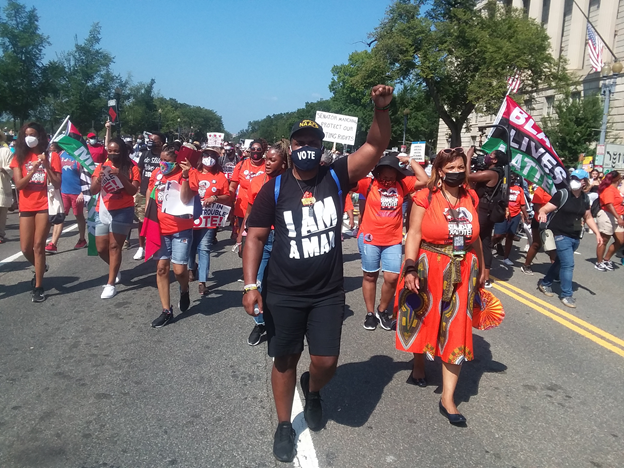
It was hot and humid in DC on Saturday, and I was thoroughly drenched with sweat by the time the March On For Voting Rights arrived in front of the US Capitol. Soon after, the three-hour rally began, with almost all of the thousands there listening from the shelter of the tree shaded grass on either side of the National Mall.

For me, the high point of the program was the consecutive speeches toward the end by 13 year old Yolanda Renee King, Andrea Waters King and Martin Luther King III, respectively a granddaughter, daughter-in-law and son of Martin Luther King, Jr. All were good, substantive, and the fact that they are a family living and working very much in Dr. King’s spirit was personally moving. My life as an activist and organizer literally began on the day he was killed in 1968, so to see and hear his family descendants speaking out so clear and strong was no small thing.

Somewhere in the course of this long, hot day, leaving Newark, NJ on the People’s Organization for Progress (POP) bus at 4 am and getting back about 9 pm, my thinking and feelings about the importance of voting rights shifted. In a way I didn’t before the DC rally, I now feel much more strongly the urgency of the effort to get the US Senate to pass voting rights legislation now.

I’m afraid that too many of us who haven’t directly experienced voter suppression—white people—look upon the right to vote too intellectually, and not from the heart. Of course we support it, we’re democrats. Of course we support it, democracy requires it. If we didn’t support everyone who is eligible to vote being able to do so, it would go against our core beliefs.

Listening to the speakers and feeling the predominantly Black folks around me at the pre-march rally and during the march, it wasn’t the same. For African Americans it is literally a matter of life and death, grounded in centuries of slavery and Jim Crow segregation and institutionalized racism, underlined by today’s out-in-the-open efforts by Republican white supremacists in state legislatures around the country to hijack elections via voter suppression.

Voter suppression has practical results for all people. It could mean the overturning of Roe vs. Wade. It means the entrenchment of the power of the fossil fuel industry at a time when their hold over Washington and other politicians means escalating droughts, fires, major storms, floods and massive human and ecological damage. It means continued and even stepped up mass incarceration of mainly Black and Brown people. It means cutbacks in funds for housing, health care and education. The list is long.

As it turned out, I carried a big POP sign all throughout the march which said, “Stop the Filibuster.” It was a popular sign; lots of people kept coming up to take a picture of it. I was glad to carry it, and as I did so and then heard speakers talking about the need to end the filibuster, at the very least for voting rights related legislation, it became clear how essential this is in 2021. The only way to get something like the John Lewis Voting Rights Act passed is for all 50 Democratic Senators to vote for it and VP Harris to provide the winning vote.

The last speaker at the Capitol Rally, Rev. Al Sharpton, talked about the filibuster. He said we needed a bunch of “filibuster-busters.” He said, “maybe we need to pitch our tents on the Mall.”

Let’s all defend the right to vote this fall, by any and every means necessary!

Ted Glick is a volunteer organizer with Beyond Extreme Energy and author of Burglar for Peace: Lessons Learned in the Catholic Left’s Resistance to the Vietnam War, published last year. Past writings and other information can be found at https://tedglick.com, and he can be followed on Twitter at https://jtglick.com.

Covid Denial on the Left

The Delta variant of Covid-19, combined with regrettable anti-vaccine sentiment, has dramatically escalated the number of covid cases, hospitalizations and deaths in the US and around the world.  The overwhelming majority in the US, over 99% in one scientific study, of those hospitalized and dying are those who have not been vaccinated. And unfortunately, there continue to be progressives who deny the importance of the vaccine to the goal of ultimately suppressing, if not defeating, the virus. They are covid deniers.

It’s difficult to be patient with covid deniers I know who have spent years of their lives advocating and working for a very different world, a much better one, than the corporate-dominated one we are living in today. On this issue, despite the 620,000 deaths in the US and over 4.2 million deaths in the world caused by it so far, with more to come, they act and speak as if those deaths and the massive suffering caused by the virus are essentially the result of a conspiracy.

It is particularly outrageous when people like Gary Null and Robert Kennedy actively encourage people to distrust the vaccine, the vaccine that is THE reason the number of deaths per day in the USA went from over 3,000 in December of 2020 to a few hundred as of this June once the vaccine was widely available and incompetent Trump was replaced by a Biden administration that took this pandemic seriously.

Most of those not getting the vaccine are Trump supporters. A much smaller percentage are people on the Left. From what I’ve read and experienced, some of that second group are people whose general distrust of government and corporations, like Pfizer, Moderna and Johnson & Johnson, underlie their vaccine reluctance.

I agree with those within this group who say that it isn’t enough to wear a mask and social distance and get a vaccine, that it’s also important that people have a healthy diet and exercise, take better care of themselves and their families. I’m critical of Dr. Fauci and Dr. Gupta and other famous medical experts on TV who rarely if ever mention this. Indeed, if they did, this could be a silver lining of covid if many more people made these changes.

And the unwillingness of the pharmaceutical companies to make available the information and the knowledge needed to manufacture the vaccine in other countries is shameful. They should be publicly criticized for their inhuman corporate greed.

But these criticisms can’t be used to discourage vaccination.

I’ve had lots of experience over my years as a progressive activist dealing with people and organizations who put ideology over facts, who refuse to accept the truth, find ways to stick to their opinions even when reality has shown them to be wrong. It’s a very human problem, with deep historical roots. It’s a big problem.

Saying that the vaccine is part of a corporate conspiracy—saying that there’s no need to take the vaccine if you just eat well, take care of yourself and take vitamin supplements—inflating the tiny percentage of cases, much less than 1%, where vaccinated people have been hospitalized or died from the Delta variant—these and other lies and distortions of the truth should not just be dismissed; they should be confronted.

This is not the time for silence. It’s time to stand up against those on the right and those on the left who are sometimes uninformed, sometimes confused, and sometimes—and these are the worst—actively trying to sabotage the efforts to beat the virus through mass vaccination.

Ted Glick is a volunteer organizer with Beyond Extreme Energy and author of Burglar for Peace: Lessons Learned in the Catholic Left’s Resistance to the Vietnam War, published last year. Past writings and other information can be found at https://tedglick.com, and he can be followed on Twitter at https://jtglick.com.